

Boat trips on the Rio Aporé
Rapids, calm backwaters and forested banks: the river that separates Goiás from Mato Grosso do Sul, seen from the water.
Updated on 2026-10-08
After the hot-spring lagoon, a motorboat trip on the Rio Aporé is the most requested outing among visitors to Lagoa Santa, in the state of Goiás, Brazil. The river runs for about 200 km over a rocky bed, with stretches of rapids and long, calm backwaters, and forms the border between Goiás and Mato Grosso do Sul. There is no formal boat-tour operator in town: trips are arranged through guesthouses and local boatmen. This guide explains how to do that, what to expect and how to stay safe.
How to book a trip
The safest route is to ask at the guesthouses on Avenida Ulisses Guimarães, the street that leads to the riverfront. The owners know the town's boatmen and usually arrange the trip or point you to someone who runs them. Pousada Sakura, phone (64) 3640-1119 (from abroad: +55 64 3640-1119), is one of the go-to contacts for river outings and fishing. Another source is the CIAT tourist information center, at (64) 3640-1224.
When arranging the trip, make clear:
- how many people are going (boat capacity is limited and there must be enough life jackets);
- whether departure is from the town's landing or from another point on the river;
- the departure time and approximate duration;
- whether the price is per person or per boat, and whether it includes fuel;
- whether there will be a stop for swimming or fishing.
There is no public price list. The cost varies with the distance covered, the number of people and the day's fuel price; ask for a fixed quote before boarding.
What you will see along the way
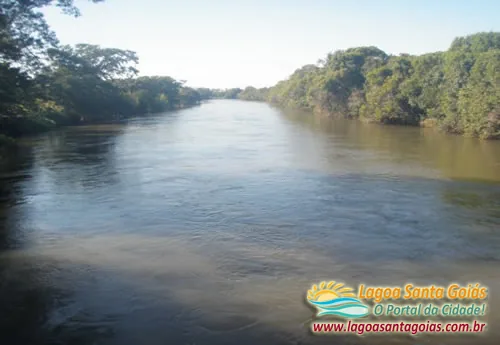
The Aporé, also known as the Rio do Peixe (Fish River), has a rocky bed and banks covered in riparian forest. The boat alternates between backwaters, where the water turns glassy and mirrors the vegetation, and stretches of rapids, where the pilot slows down and steers around the rocks. Herons, kingfishers and cormorants are common sights, and capybaras on the banks. In the shallower backwaters the water is clear enough to see the stone bottom.
A detail few visitors know: a channel carries the overflow from the hot-spring lagoon down to the river. Depending on the stretch, the boatman will show you where that warm water enters the Aporé. In the other direction, downstream, the Aporé continues until it flows into the Rio Paranaíba, and the border stretch is marked by spots well known to anglers, such as the district of São João do Aporé and, much farther on, the Porto Alencastro bridge, already in the municipality of Paranaíba (MS). Not every trip goes that far; it depends on what you arrange.
How long it takes
The duration varies with the route agreed. Short sightseeing trips run around an hour; routes with a stop for a swim in a backwater or for fishing can take the whole morning. Agree on the total time and the return time beforehand, especially if there are children on board or if you plan to head back to the hot-spring lagoon the same day.
Safety on the river
Life jackets for everyone, no exceptions. If the boatman does not have enough life jackets, do not board. Children wear a properly sized jacket with a crotch strap.
- River level: the Aporé rises fast after rain upstream, even when the sky over Lagoa Santa is clear. In the rainy season from October to March, ask the boatman how the river is running and avoid rapids in high water.
- Stormy weather: with thunderstorms in sight, the trip is postponed. Lightning on open water is a real risk.
- Rocks: the riverbed is rocky. Do not jump off the boat in a spot you do not know; backwaters look deep and sometimes are not.
- Alcohol: does not mix with river, sun and rapids. Save it for after the trip.
- Sun: hat, sunscreen and a long-sleeved shirt; the glare off the water doubles your exposure.
- Phone: in a dry bag; there are stretches with no signal.
Best time of day and photos
Early morning is unbeatable: glassy water, light wind, low sun and, between June and August, mist over the river, which makes for the most beautiful photos. Late afternoon is the second choice, with the sun setting toward Mato Grosso do Sul. Avoid midday, when the light is harsh and the heat on the boat is intense.
For photography, bring your camera or phone with a strap and keep the lens dry through the rapids. The best shots come from the backwaters, with the forest mirrored in the water, and from the stretches where the boat cuts through the water at dawn. See examples in the photo gallery.
Combining the trip with fishing
Many visitors hire a boat precisely to fish. The Aporé is known for sport fishing and hosts the town's Fishing Festival. If fishing is the plan, agree with the boatman on the spots, the time (the pre-dawn hours are most productive) and what is allowed: respect the spawning closure, catch limits and protected species. Details, bait and rules are under Fishing in Lagoa Santa and Fishing Festival.
Where do I book a boat trip in Lagoa Santa?
At the guesthouses on Avenida Ulisses Guimarães, by the riverfront, or through the CIAT at (64) 3640-1224. Pousada Sakura, (64) 3640-1119, is one of the go-to contacts for river trips and fishing.
How much does it cost and how long does it last?
There is no public price list; the cost depends on the route, the number of people and fuel. Trips last from about an hour to a full morning. Ask for a fixed quote before boarding.
Is it safe to bring children?
Yes, as long as every child has a properly sized life jacket, the river is at a normal level and the trip avoids the rapids. Go in the morning, when the wind is lighter.