

History of Lagoa Santa
A hot-water lagoon, frontiersmen in search of land, and a town born from the healing bath.
Updated on 2026-10-08
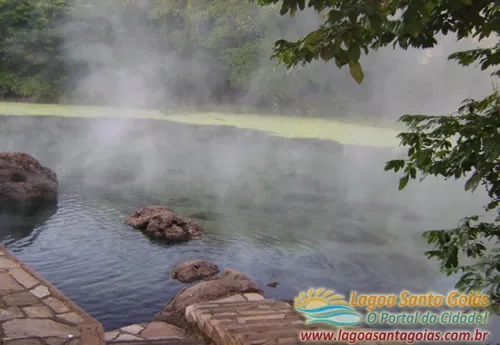
Lagoa Santa, in the state of Goiás, Brazil, has two discovery stories that residents tell side by side. Both end in the same place: a lagoon of hot, clear water teeming with fish, where those who bathed felt their bodies grow better. It was that "power of the water" that gave the place its name (Lagoa Santa means "Holy Lagoon") and, more than a century later, gave rise to the municipality.
The frontiersmen and the "holy" lagoon (19th century)
According to the oldest residents, settlement of the area began between 1880 and 1890, with frontiersmen (sertanistas) coming down from Minas Gerais in search of fertile land. One of them, the rancher Vergílio Ferraz, remembered today as a pioneer, set out hunting with two natives of the region and, traveling along the waterways, reached the banks of the Córrego Fundo stream, where the Córrego Fundo and Sossego farms stand today.
There, Vergílio's companions found a lagoon of hot, transparent water with a great variety of fish. They bathed, felt signs of improvement in their bodies, and credited the water with medicinal properties. The name Lagoa Santa was born.
Days later, Vergílio sent for his wife, Luisinha, and their five children, who came to live in the area at a place called Imóvel Jaborandi, today Fazenda Caçula. Their descendants and the Moraes family built a simple country boarding house to shelter visitors from all over the country, who stayed 20 to 30 days seeking a cure in the waters. It was the settlement's first business.
The hunter's version (early 20th century)
The City Hall records another version, also passed down by word of mouth: the lagoon is said to have been discovered by the hunter Manoel Clemente de Rezende in the early 20th century, probably between 1900 and 1905. Located on the left bank of the Rio Aporé, on the border with what is now Mato Grosso do Sul, it gradually drew anglers and bathers who little by little settled around it.
The two accounts are not mutually exclusive. The memory of small places often keeps more than one "discoverer", and the essentials coincide: the fame of the hot waters spread early and brought people from far away.
From healing bath to thermal complex (1971–1990)
For many decades the lagoon remained a rustic destination: simple lodgings, a soak in the hot water and fishing on the Aporé. That began to change in 1971, when mineral-water entrepreneur Antônio de Oliveira Rocha visited the site at the invitation of the DNPM, Brazil's National Department of Mineral Production. He presented a plan for a tourist complex and, in 1972, obtained the mining concession for the waters.
To make the venture possible, Rocha negotiated the purchase of the holdings of 51 families who occupied the land around the lagoon. Construction of the complex began in 1985, and in July 1990 the Hotel Thermas Lagoa Santa opened, with a hotel, a convention center, pools and a 370,000 m² park of protected forest, designed to have the smallest possible impact on the spring. That complex still houses the lagoon and manages visitor access today.
District, municipality and independence (1988–2001)
On January 14, 1988, State Law 10,446 created the district of Termas de Itajá, under the municipality of Itajá. After ten years of growth, the district won its autonomy: State Law 13,134, of July 21, 1997, raised it to the status of a municipality under the name Lagoa Santa, split off from Itajá. Its boundaries were adjusted by Law 13,241, of December 28, 1998.
The municipality was officially installed on January 1, 2001, when its first own government took office. Since then it has consisted solely of the seat district, and it celebrates its anniversary on July 21, the date of the independence law.
Lagoa Santa in numbers, over time
| Year | Population | Source |
|---|---|---|
| 2007 | 1,225 inhabitants (852 urban, 373 rural) | IBGE population count |
| 2010 | 1,254 inhabitants | IBGE census |
| 2022 | 1,390 inhabitants | IBGE census |
The municipality covers about 463 km², roughly 0.13% of the territory of Goiás. The town center sits at an elevation of 380 meters.
Timeline
- c. 1880–1890 – frontiersmen arrive in the region; Vergílio Ferraz and companions find the hot-water lagoon.
- c. 1900–1905 – the version of the discovery by hunter Manoel Clemente de Rezende.
- 1971 – Antônio de Oliveira Rocha visits the lagoon at the invitation of the DNPM and proposes a tourist complex.
- 1972 – mining concession granted for the thermal waters.
- 1985 – construction of the complex begins.
- 1988 – creation of the district of Termas de Itajá.
- 1990 – opening of the Hotel Thermas Lagoa Santa, in July.
- 1997 – independence: Lagoa Santa becomes a municipality on July 21.
- 2001 – the municipality is installed on January 1.
- 2009 – this portal goes online.