

Geography, wildlife and flora of Lagoa Santa
Where the municipality is, what the terrain is like, the climate through the year, and the animals and plants that surround the hot-spring lagoon.
Updated on 2026-10-08
Lagoa Santa occupies the far south of the state of Goiás, Brazil, hugging the Rio Aporé, which separates the state from Mato Grosso do Sul. That is about 463 km² for just 1,390 inhabitants (2022 census): a great deal of cerrado savanna, pasture and forest for very few people. This page covers location, terrain, rivers, climate, vegetation and wildlife, with a practical section for anyone who enjoys birdwatching.
Location and boundaries
The town center lies at approximately 19°10′ S and 51°23′ W, on the left (Goiás) bank of the Rio Aporé. Administratively, Lagoa Santa belongs to the Sul Goiano mesoregion and the Quirinópolis microregion. The municipality is almost an island within Itajá: it borders that municipality to the north, east and west. To the south, the boundary is the river itself, and across the water is Mato Grosso do Sul.
The nearest town is Itajá, 20 km away on the GO-302 highway. Paranaíba (MS) is about 75 km away, Rio Verde some 200 km and Goiânia roughly 430 km. Routes are detailed under how to get there and distances.
Terrain and elevation
The terrain is gentle, typical of southern Goiás. The town center sits at 380 m above sea level, and the rest of the municipality varies little: low hills, open valleys and flat pastureland. There are no mountain ranges or tall hills; what breaks the horizon line is the riparian forest along the streams and, above all, the Aporé valley, where the ground drops down to the river's rocky bed. In practice, the streets are flat, and reaching the lagoon and the river requires no physical effort.
Waterways: the Aporé, the lagoon and the channel
All the water in the municipality drains into the Rio Aporé, which runs for about 200 km and empties into the Rio Paranaíba, one of the headwaters of the Paraná. A river with a rocky bed, the Aporé runs lower and clearer in the dry season and rises with force in the rains.
The lagoon that gives the town its name is a thermal spring: the water emerges at around 31 °C (ranging between 29 and 33 °C), at a flow of some 3.6 million liters per hour, and is rich in calcium, magnesium and sodium bicarbonates. It lies inside the Thermas Lagoa Santa park on the GO-302 highway, and the overflow runs through an open channel down to the river. Near the mouth of that channel, the water of the Aporé is slightly warm. Details are in the guide to the thermal springs.
The Guarani Aquifer
The lagoon's water comes from the Guarani Aquifer, one of the largest underground freshwater reservoirs in the world, stretching beneath parts of Brazil, Argentina, Paraguay and Uruguay. In Lagoa Santa the aquifer surfaces: water that seeps in at the recharge areas travels through deep layers of sandstone, is heated by the warmth of the earth's crust and returns to the surface through the spring. That is why the temperature does not change with the seasons and why the water emerges laden with minerals dissolved from the rock.
The lagoon is not an ordinary lake that depends on rainfall. It is an outlet of the aquifer. That explains why it never dries up in August and never cools down in July.
Climate month by month
The climate is tropical, with two well-defined seasons: dry from May to September and rainy from October to March. Temperatures range from about 17 °C in the early hours of winter mornings to 31 °C or more on hot afternoons, with average humidity around 70%. June, July and August are the most comfortable months. The table is an approximate reference based on the regional pattern; for the day of your trip, check the weather forecast.
| Month | Season | Min. / max. (approx.) | What it is usually like |
|---|---|---|---|
| January | Rainy | 21 / 31 °C | Near-daily afternoon downpours, muggy heat, green landscape. |
| February | Rainy | 21 / 31 °C | Similar to January; river full and dark. |
| March | Rainy | 21 / 31 °C | The rains start to space out toward the end of the month. |
| April | Transition | 19 / 30 °C | Drier days, mild nights; a good time with few visitors. |
| May | Dry | 17 / 29 °C | The dry season begins; cool mornings, clear skies. |
| June | Dry | 15 / 28 °C | Cold early mornings, mist over the lagoon at dawn. |
| July | Dry | 15 / 29 °C | Coldest and busiest month; the town's anniversary on the 21st. |
| August | Dry | 17 / 31 °C | Very dry air, hot afternoons, smoke from brush fires in the region. |
| September | Dry | 19 / 32 °C | Hottest month; rain may arrive at the end. |
| October | Rainy | 20 / 32 °C | First heavy rains, heat, cerrado in bloom. |
| November | Rainy | 21 / 31 °C | Frequent rain, high humidity, river rising. |
| December | Rainy | 21 / 31 °C | Rainy and hot; visitor numbers grow at the end of the year. |
Vegetation
Lagoa Santa lies in an ecological tension zone: a belt where the cerrado savanna meets the seasonal forest, the woodland that sheds part of its leaves in the dry season. As a result, within a few kilometers you find both open cerrado, with low, twisted trees, and stretches of tall, dense forest along the river and streams. Species recorded in the municipality:
- sucupira-branca (Pterodon)
- pimenta-de-macaco (monkey pepper tree)
- jatobá-do-campo and jatobá-da-mata (Brazilian copal trees)
- caroba (Jacaranda)
- pequizeiro, whose fruit, the pequi, is the foundation of Goiás cooking
- pau-d'óleo (copaiba)
- angico
- sobro
- pindaíba-ferrugem
- açoita-cavalo
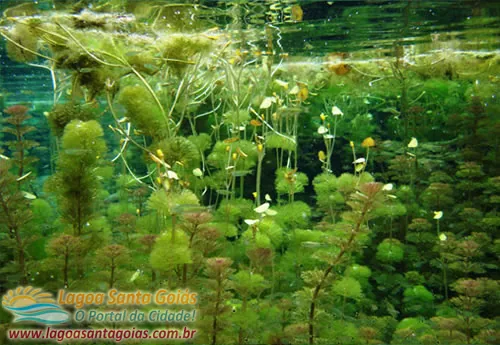
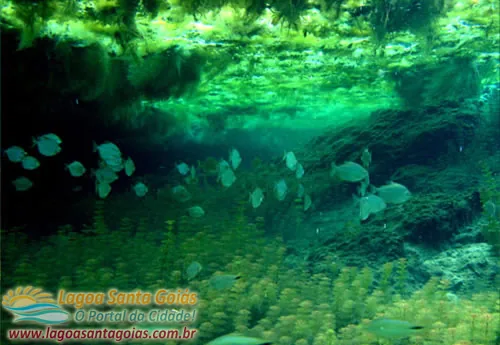
Inside the lagoon, the clean, warm water sustains carpets of submerged aquatic plants, visible from the boardwalk and in the underwater photos in our gallery. The Thermas park preserves 370,000 m² of native forest around the spring.
Wildlife
What stands out most is the number of birds. The combination of riparian forest, cerrado and year-round water attracts species uncommon in other regions, such as the whistling heron (maria-faceira), the helmeted manakin (soldadinho) and the saffron-billed tanager (saíra-amarela). Birds seen with some regularity:
- whistling heron, a heron with a streaked neck, perched on the river rocks
- helmeted manakin, tiny, with a bright red crest
- saffron-billed tanager, in flocks in the treetops
- greater rhea, in the open pastures
- rufous hornero (joão-de-barro), with its mud nests on posts and trees
- rufous-bellied thrush, singing at dawn and late afternoon
- blue-and-yellow macaw, flying high, in pairs or small groups
- burrowing owl, on embankments and vacant lots
- neotropic cormorant, diving after fish in the Aporé
- white-winged swallow, skimming low over the water
Mammals are more discreet. With luck, at dawn or dusk along the riverbanks and on back roads, you may spot capybaras, the giant anteater and the crab-eating fox. In the lagoon, the attraction is the fish, in plain sight in the transparent water; the river species are on the fishing page.
Birdwatching tips
- Get up early. The first hour of light, between 5:30 and 7 a.m., has the most activity. Late afternoon is the second-best time.
- Bring binoculars. An 8x42 model handles most situations; the riparian forest of the Aporé is dense and the birds keep their distance.
- Stay quiet and walk slowly. Stop often and wait; many species only show themselves after a few minutes of stillness.
- Pick your habitat. Riverbank for cormorants, white-winged swallows and whistling herons; the park's forest for tanagers, manakins and thrushes; dirt roads and pastures for rheas, burrowing owls and horneros.
- Favor the dry season. From May to September, sparser foliage and clear skies make spotting easier.
- Do not use playback or feed the animals. Recorded calls stress the birds, and food changes the behavior of capybaras and fish.
- Neutral-colored clothing, insect repellent, water and a hat complete the kit. See more under tips.