

Thermal springs of Lagoa Santa
A natural lagoon, warm all year round, clear as an aquarium and surrounded by native forest in the far south of Goiás, Brazil.
Updated on 2026-10-08
The hot-spring lagoon is the reason Lagoa Santa, in the state of Goiás, Brazil, exists as a town. Water rises from the ground at about 31 °C, runs clean enough for you to watch fish swim between your legs, and sits inside a 370,000 m² grove of protected forest. This guide explains how the water gets there, what to expect from a dip, how much it costs to get in and how to make the most of your visit.
Where the hot water comes from
The lagoon is not heated by any equipment. The water comes from the Guarani Aquifer, the vast underground reservoir that stretches beneath central and southern Brazil, and rises through natural springs to the surface already warm, with a spontaneous flow estimated at 3.6 million liters per hour (3,600 m³/h), one of the largest thermal-water flows known in Brazil. Because of this enormous volume, the lagoon's water is constantly renewed: the overflow drains through a channel into the Rio Aporé, which runs a few kilometers away.
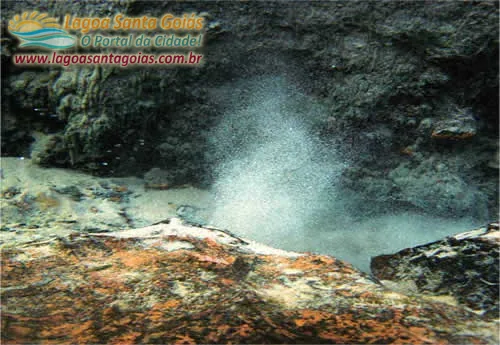
This continuous renewal is what explains the clarity. Since the water never sits still, there is no buildup of sediment or suspended algae. At several points on the bottom you can see the sand shifting where water is bubbling up, what visitors call the "bubbles." The most beautiful photos of the lagoon floor are taken at exactly these spots.
Water temperature and composition
The temperature varies very little over the year. The most frequently cited measurements fall between 29 and 31 °C, and City Hall reports a range of 29 to 33 °C depending on the spot in the lagoon, with an average of 31 °C: warmer near the springs, slightly milder at the edges. In July, when early mornings in Lagoa Santa can drop close to 10 °C, the difference between air and water produces the mist that rises from the lagoon at dawn. In summer the water merely feels "cool" compared with the heat outside, but it stays at the same temperature.
The water is classified as thermal, mineral and sulfurous, rich in calcium, magnesium and sodium bicarbonates. The published physical and chemical parameters for the lagoon are these:
| Parameter | Value | What it means in practice |
|---|---|---|
| Temperature | 29 to 31 °C (average 31 °C) | Warm all year, with no significant seasonal variation |
| pH | 7.2 | Practically neutral, close to that of the skin |
| Carbonate hardness (KH) | 7 | Moderately buffered, stable water |
| General hardness (GH) | 4 | Soft water that does not dry out the skin |
| Dissolved CO₂ | 8 to 14 ppm | Favors the aquatic plants that carpet parts of the bottom |
| Phosphate (PO₄) | < 0.01 | Almost absent, which helps keep the water clean |
| Iron (Fe) | 0 ppm | No discoloration or metallic taste |
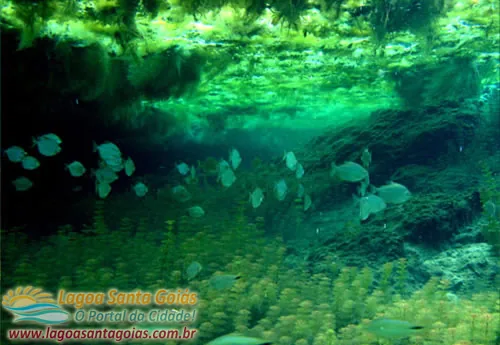
These are the same numbers aquarium hobbyists use to assess a planted tank, and not by chance: the lagoon works like a giant natural aquarium, with submerged plants, schools of fish and visibility of several meters.
What bathing is like
The lagoon lies inside the Thermas Lagoa Santa complex (Highway GO-302, Km 19), which brings together the hotel and the bathing park. From the parking lot to the water you walk along wooden boardwalks that cross the forest. There are stone steps and metal ladders at several points for getting into the water, plus stretches of shallow shoreline where children tend to gather.
The depth varies a great deal. At the edges you can easily stand; in the middle there are deeper pools with rocks and plants on the bottom. Since the water is warm and the body relaxes quickly, many people simply float. If you bring a dive mask or swim goggles you get a whole extra outing: the fish do not flee, and it is common to see schools passing within a few centimeters.
The faint smell of sulfur, typical of sulfurous water, is noticeable near the springs and fades after a few minutes. It does not stain swimwear or leave any residue on the skin.
The best time: a misty dawn
If you could pick a single moment to enter the lagoon, pick early morning between June and August. With cold air and 31 °C water, a dense mist rises to cover the surface, and the sun cuts through the forest in shafts of light. It is the setting of the town's most famous photos, and it does not last long: an hour after sunrise the mist has already dissipated.
Hotel guests have earlier access. Day-use visitors should confirm the bathing park's opening time by phone and arrive the moment the gates open. Late afternoon is the second-best time, with low light and fewer people.
How much it costs and how to visit
- Day-use ticket: around R$ 40 per person, Brazilian reais (approx. USD 7), according to a 2023 visitor report. This is a reference value; confirm with Thermas before traveling, because holidays and high season may have a different price list.
- Hotel guests: free access to the lagoon throughout their stay.
- Contact: phone (64) 3640-1122 (from abroad: +55 64 3640-1122), WhatsApp (64) 99963-7039, website thermaslagoasanta.com.br.
- Facilities: changing rooms, restaurant, rest area and forest trails. Bring your own towel.
The town is roughly 430 km from Goiânia and 20 km from Itajá. See detailed routes in How to get there and the guesthouse and hotel options in Where to stay.
Precautions and good manners in the lagoon
Stay hydrated. Warm water increases perspiration without you noticing. Drink water before getting in and every 30 or 40 minutes of bathing. Avoid alcohol before a dip: the heat of the water combined with alcohol lowers blood pressure and causes dizziness.
- Bathing time: alternate 20- to 30-minute spells in the water with breaks in the shade. Pregnant women and people with high blood pressure, heart conditions or circulatory problems should talk to their doctor first and keep their dips short.
- Children: the water is warm and inviting, but there are deep stretches and the bottom is rocky. Keep children in sight at all times and use arm floats on the little ones.
- No tanning oil or body oil: it forms a film on the surface and harms the water the fish and plants depend on. If you use sunscreen, choose a biodegradable one and apply it well in advance so it absorbs.
- Do not feed or try to catch the fish. They come up to you on their own.
- Do not step on the submerged plants or pull anything off the bottom.
- Trash goes back with you. There is no collection inside the forest.
More practical guidance for the whole trip is on the tips page.
From farm boarding house to the Thermas complex
The local tradition that the lagoon heals began with the first backcountry pioneers who reached the region between 1880 and 1890. The most often told version credits the discovery to Vergílio Ferraz, a rancher from Minas Gerais who bathed in the lagoon during a hunt, felt relief and named the place Lagoa Santa ("Holy Lagoon"); another version from oral memory attributes the find to the hunter Manoel Clemente de Rezende, around 1900 to 1905. Both stories end the same way: descendants of the pioneers built a simple boarding house, and visitors from all over the country began staying 20 to 30 days for daily baths. The full story is in History of Lagoa Santa.
The current complex came much later. In 1971, mineral-water businessman Antônio de Oliveira Rocha visited the lagoon at the invitation of the DNPM, Brazil's National Department of Mineral Production, and obtained the mining decree in 1972. Construction began in 1985, after the purchase of land from 51 smallholders around the lagoon, and the Hotel Thermas Lagoa Santa opened in July 1990. It was this venture, together with the flow of visitors, that turned the then district of Termas de Itajá into a municipality in 1997.
The "medicinal" properties
Nobody promises a cure today, but the effects of warm, bicarbonate-rich mineral water on muscle relaxation, sleep and a general sense of well-being are real and felt by every visitor. Treat the lagoon for what it is: one of the most pleasant natural baths in Brazil's Center-West, not a medical treatment.
Is the lagoon artificially heated?
No. The water comes from the Guarani Aquifer and rises from underground already warm, averaging 31 °C, with a natural flow of about 3.6 million liters per hour. There is no boiler and no pumping to heat it.
Can I get into the lagoon without staying at the hotel?
Yes. The Thermas Lagoa Santa bathing park sells day-use tickets, with a reference price of around R$ 40 per person (2023 report). Confirm prices and hours by phone at (64) 3640-1122.
Can I bring a dive mask or snorkel?
You can, and it is worth it. The water is clear and the fish come up to bathers. Just do not touch the plants on the bottom and do not chase the animals.
When is the best time to see the mist over the water?
On cold mornings from June to August, right at sunrise. The bigger the difference between the air temperature and the water's 31 °C, the denser the mist.
Does the sulfurous water smell strong?
There is a faint smell of sulfur near the springs, which most people stop noticing within a few minutes. It does not stain clothing or irritate the skin.
Plan your dip at a relaxed pace
See the two-day itinerary with suggested times for the lagoon, the boardwalks and the Rio Aporé.