

Goiás Waters Route: where Lagoa Santa fits in
The tourist circuit of the hot waters of Goiás and the place within it of the natural lagoon in the far south of the state.
Updated on 2026-10-08
Goiás is Brazil's state of hot waters, and state tourism organizes this heritage into a tourist region called the Roteiro das Águas (Waters Route), or the thermal waters region of Goiás. Caldas Novas and Rio Quente are the famous part; Lagoa Santa, in the far south, is the small, natural part. This page explains what the region is, where Lagoa Santa fits in and how to combine the two hubs in a single trip.
What the Goiás waters region is
Official Goiás tourism promotion groups the state's municipalities into tourist regions, and the waters region brings together towns with thermal waters, rivers, lakes and waterfalls, mainly in the south and southwest of Goiás. According to this promotion, the region covers about 40 municipalities. Among them, three have hot water as their central attraction and can be named with certainty:
- Caldas Novas, the largest hydrothermal resort in the world by volume of water, with about 100,000 inhabitants and dozens of water parks and hotels.
- Rio Quente, next to Caldas Novas, home to the Rio Quente Resorts complex and Hot Park.
- Lagoa Santa, with a single natural lagoon of thermal water at 31 °C, in the far south of the state, on the border with Mato Grosso do Sul.
The other municipalities in the region contribute waterfalls, fishing rivers, hydroelectric reservoirs and rural tourism. Since the composition may change from one edition of the state tourist map to another, we name only the three that leave no doubt.
Where Lagoa Santa fits in
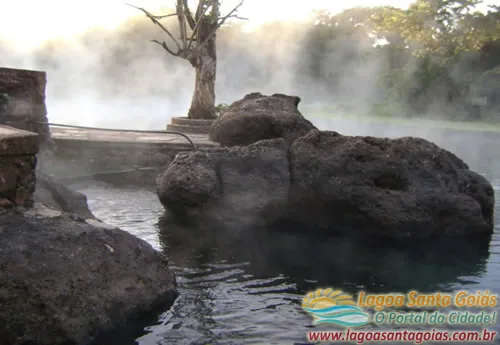
Lagoa Santa is the most distant and quietest point of the circuit. It is about 450 km from Caldas Novas (approximately) and 430 km from Goiânia, on the bank of the Aporé River. The water comes from the Guarani Aquifer, emerges at 29 to 33 °C with a flow of 3.6 million liters per hour, and forms a transparent lagoon, surrounded by 370,000 m² of woods, where fish swim alongside bathers. The town has 1,390 inhabitants, and the tourist infrastructure comes down to the Thermas complex, the Kin Gin water park and family-run guesthouses.
In other words: if Caldas Novas and Rio Quente represent the side of parks, water slides and resorts, Lagoa Santa represents the side of nature and rest. The two experiences do not compete; they complement each other.
Differences between the hubs
| Caldas Novas / Rio Quente | Lagoa Santa | |
|---|---|---|
| Type of bathing | Pools and water parks with pumped thermal water | Natural lagoon, with visible fish and plants |
| Size | ~100,000 inhabitants, dozens of hotels and parks | 1,400 inhabitants, one thermal complex and guesthouses |
| Crowds | Heavy, especially on holidays | Quiet all year; full only in July, at Carnival and at year-end |
| Reference price | Hot Park from ~R$ 242 per adult (2026); hotels in various price ranges | Day use from R$ 30 to R$ 60 per person (g1, Oct/2024; confirm) |
| Distance from Goiânia | ~170 km | ~430 km |
| Ideal for | Families who want parks and nightlife | Those looking for nature, silence, fishing and photos |
The detailed comparison is on Lagoa Santa or Caldas Novas.
Suggested itinerary: both hubs in one trip
The combination works for those who have five to seven days and set off from Goiânia or Brasília by car.
- Days 1 to 3: Caldas Novas and Rio Quente. From Goiânia it is about 170 km. Water parks, Hot Park (open Friday to Wednesday, 10 a.m. to 5 p.m.; guests at Rio Quente Resorts hotels have access included), hotels with thermal pools, restaurants and nightlife.
- Day 4: travel day. From Caldas Novas to Lagoa Santa it is approximately 450 km, on the highways of southern Goiás, passing through the Rio Verde, Caçu, Itarumã and Itajá region. Leave early, fill up in Rio Verde or Caçu and arrive in daylight; there are stretches with no signal and animals on the road at night. Check the route on Getting there.
- Days 5 to 7: Lagoa Santa. Morning at the thermal lagoon with the mist, afternoon on the Aporé River by boat or fishing, a day of rest on the boardwalks in the woods. Use the two-day itinerary as a base.
Travelers from São Paulo can reverse it: enter through Paranaíba (MS) to Lagoa Santa, then go up to Caldas Novas before returning via Goiânia or the Triângulo Mineiro. In either direction, avoid doing the 450 km between the hubs and the bathing on the same day.
When to go
The waters region has two well-defined seasons. From May to September it is dry and cold in the early morning: that is when the difference between the air and the water produces the mist over the lagoon in Lagoa Santa and makes the pools of Caldas Novas more inviting. July is the busiest month at both hubs. From October to March it rains in the afternoon and the heat is strong; the water stays at the same temperature, but the mist disappears and the roads require more care. For Lagoa Santa, details on When to go.
The prices mentioned are for reference (Hot Park 2026, Lagoa Santa day use 2023) and the distances are approximate. Confirm everything before you travel. The Thermas Lagoa Santa rate list is at thermaslagoasanta.com.br/tarifario.
Is Lagoa Santa part of the Goiás Waters Route?
Yes. Lagoa Santa is one of the thermal-water municipalities of the Goiás waters tourist region, alongside Caldas Novas and Rio Quente. The region brings together about 40 municipalities, according to official promotion.
How far is it from Caldas Novas to Lagoa Santa?
About 450 km, approximately, on the highways of southern Goiás. It is a day of travel; leave early and arrive before dark.
Is it worth visiting both hubs on the same trip?
With five days or more, yes. Caldas Novas and Rio Quente offer the parks and the infrastructure; Lagoa Santa offers the natural lagoon, the river and the silence. They are different experiences that complement each other.